

MF-PRISM-MATH-2026-02 / v1.3
Candidate preprint · Not peer reviewed
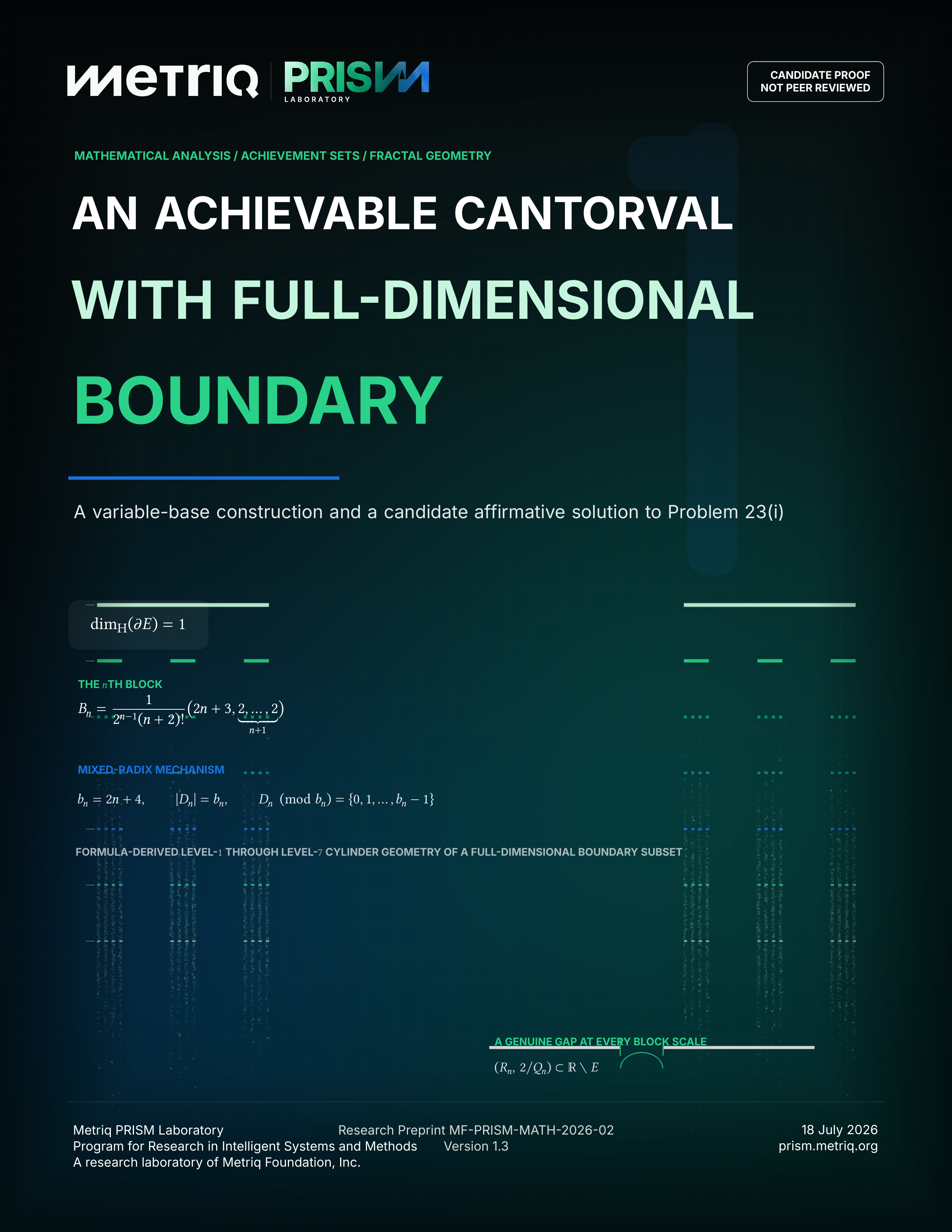
An Achievable Cantorval with Full-Dimensional Boundary
A variable-base achievement-set construction presented as a candidate affirmative solution to Problem 23(i): the existence of an achievable Cantorval whose boundary has Hausdorff dimension one.
The question, construction, and claim.
This page is an interactive guide to the preprint. The manuscript and source package remain the controlling research record.
MF-MATH-2026-02, whose release remains preserved. Metriq PRISM Laboratory is the organizational creator; Daniel H. Jeffery is Research Director and corresponding contributor. Review the current files on GitHub ↗Can an achievable Cantorval have a boundary whose Hausdorff dimension is the full ambient dimension 1?
How the paper approaches it
The construction uses increasing even radices. Each block supplies complete residues for interior and a protected family of branches whose count grows factorially at almost the same logarithmic rate as the geometric denominator.
What the result would establish
The result would show that a Cantorval boundary can be topologically thin while remaining metrically full-dimensional.
The proposed achievement set is a Cantorval and contains a protected boundary subset with Hausdorff dimension 1; therefore the full boundary also has dimension 1.
Work with the construction.
These interfaces reproduce finite structures and diagnostics described by the paper. They are explanatory tools, not substitutes for the infinite proofs.
Inspect the mixed-radix geometry.
The first control builds a finite outer approximation. The second tracks the protected branch-to-scale ratio used in the dimension argument.
Mixed-radix outer approximation
Protected branch dimension diagnostic
How the argument is assembled.
The paper separates the claim into proof obligations that can be reviewed independently.
Complete residues
Show each block digit set contains exactly one representative of every residue modulo bₙ = 2n + 4, yielding interior through mixed-radix prefix control.
Gaps and topology
Use an exact block-tail identity to generate infinitely many gaps and invoke the corrected achievement-set classification theorem.
Protected boundary
Select n + 1 protected branches at level n. Prove their prefix words are injective and separated at scale 1/Qₙ.
Mass distribution
Place equal product mass on the protected cylinders and establish a Frostman estimate. Since log((n + 1)!)/log(Qₙ) tends to 1, the protected set has dimension 1.
Exact checks and their limits.
Verification scripts test finite identities and consistency conditions. They do not replace the symbolic proofs of infinite statements.
Exact structural checks passed.
First blocks:
 n   ell_n   b_n       Q_n   |D_n|  |A_n|
 1       2     6          6       6      2
 2       3     8         48       8      3
 3       4    10        480      10      4
 4       5    12       5760      12      5
 5       6    14      80640      14      6
 6       7    16    1290240      16      7
 7       8    18   23224320      18      8

Dimension diagnostics log(M_n)/log(Q_n):
n=  2: 0.462843304747
n=  3: 0.514765781785
n=  5: 0.582350570998
n= 10: 0.667376474715
n= 20: 0.736200828264
n= 50: 0.800785782353
n=100: 0.834134123125
n=200: 0.858423196698

Partial total through block 299: 1.810229834398975
Analytic bound in manuscript: total < 2.
Formula-derived visuals.
The source package includes the scripts and files used to generate these figures.


Where criticism is most valuable.
A useful review identifies the exact theorem, equation, inference, or prior-art issue involved and distinguishes fatal defects from repairable exposition.
Protected gaps
Verify each protected local gap lies inside its isolated parent cylinder and both endpoints belong to the achievement set.
Prefix geometry
Check recursive uniqueness modulo bₙ, spacing by 1/Qₙ, and exact cylinder masses under the product measure.
Frostman estimate
Audit the interval-count cases, the bounded auxiliary sequence, and the limiting dimension calculation.
Cite the version you reviewed.
State that the result was a candidate preprint and had not undergone peer review at the time of citation.
Metriq PRISM Laboratory. (2026). An Achievable Cantorval with Full-Dimensional Boundary (Version 1.3) [Candidate research preprint]. Metriq Foundation, Inc. https://doi.org/10.5281/zenodo.21434547