Build the generating series
Package the lattice-walk counts into a formal power series so the whole sequence can be studied at once.
INTERACTIVE RESEARCH GUIDE
Separate the constraints of a three-dimensional walk, then count their interleavings.
Coordinate a stays nonnegative and returns to zero. Coordinate c stays nonnegative but may end anywhere. Coordinate e is unrestricted.
The exact coordinate formula gives a6 = 3,911. Its recurrence residual is 0.
aₙ = Σ n!/(r!s!t!) · Aᵣ · Cₛ · 2ᵗ, with r+s+t=n
Set length to 4: the coordinate formula gives 188, and the recurrence residual is exactly zero.
What this experiment represents. The coordinate-count formula and recurrence follow MATH-2026-09. Counts in the displayed range are exact integers; the Bessel factorization and general proof are not re-proved here.
A recurrence proof with exact Ore-operator verification
A proposed proof of Mathar's conjectured recurrence for the Type-ace lattice-walk sequence OEIS A302186. Exact verification covers coefficients through n=100 and the Ore-operator identity.
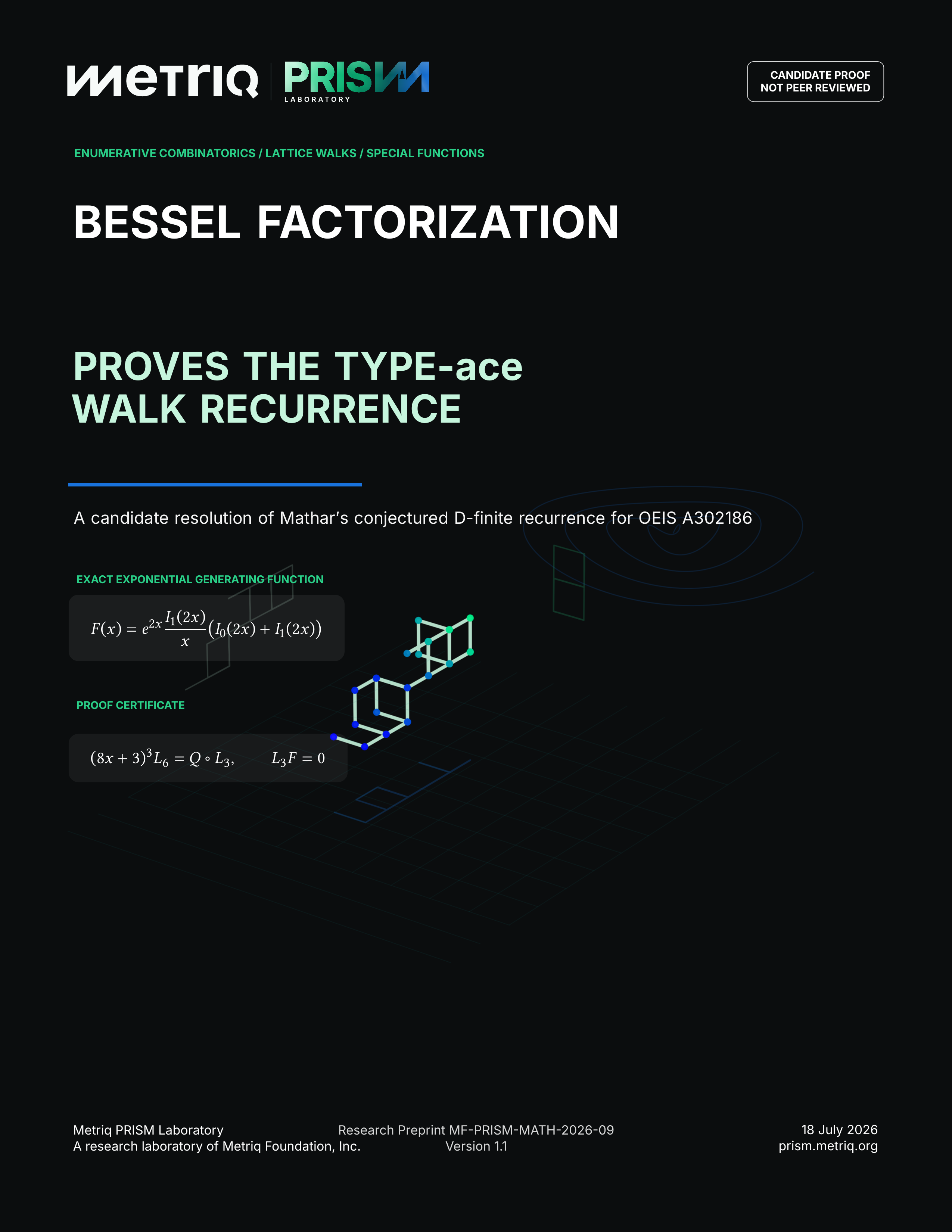
The paper explains a conjectured lattice-walk recurrence by factoring the generating function into Bessel-function pieces and transferring that structure into an exact recurrence operator.
A recurrence predicts each term of a sequence from earlier terms. Mathar observed such a rule for a Type-ace lattice-walk sequence, but a numerical pattern is not yet an explanation.
This paper’s proposed explanation passes through special functions. It rewrites the walk-generating series using Bessel factors, derives the differential or operator relation they satisfy, and converts that relation back into the conjectured recurrence.
Package the lattice-walk counts into a formal power series so the whole sequence can be studied at once.
Express the series using Bessel-type components whose differential behavior is already structured.
Use an Ore-operator identity to convert the factorization into the claimed coefficient recurrence, then verify coefficients exactly through n = 100.
The conjectured recurrence is given a structural derivation rather than only a numerical fit.
The factorization, formal-series coefficients, and recurrence operator are checked exactly.
The manuscript targets OEIS A302186 and does not claim a recurrence theorem for unrelated lattice-walk models.
Proposed proof released for independent specialist and publication-priority review.
This manuscript presents a candidate resolution. Publication is not verification: independent specialist review remains necessary before the result should be treated as established.
Exact verification to a large finite order supports the proof but cannot replace review of the symbolic derivation.
The claim is specific to the Type-ace sequence and its stated generating function.
Novelty and publication priority remain separate from mathematical correctness.
A proof would replace a conjectured numerical pattern with a structural explanation tied to special functions and operator factorization.
These are the terms needed to understand the claim. The full paper uses them more precisely.
A walk whose steps follow allowed moves on a regular grid.
A formal series that stores an entire sequence in its coefficients.
A classical special function satisfying a structured differential equation.
An algebraic operator used to represent differential or recurrence relations exactly.
This page is a reading guide, not a substitute for the manuscript. The public record links the explanation to the paper, source package, review materials, and persistent identifier.