

MF-PRISM-MATH-2026-01 / v1.3
Candidate preprint · Not peer reviewed
An Explicit Cantorval Achievement Set with Convergent Consecutive-Term Ratio
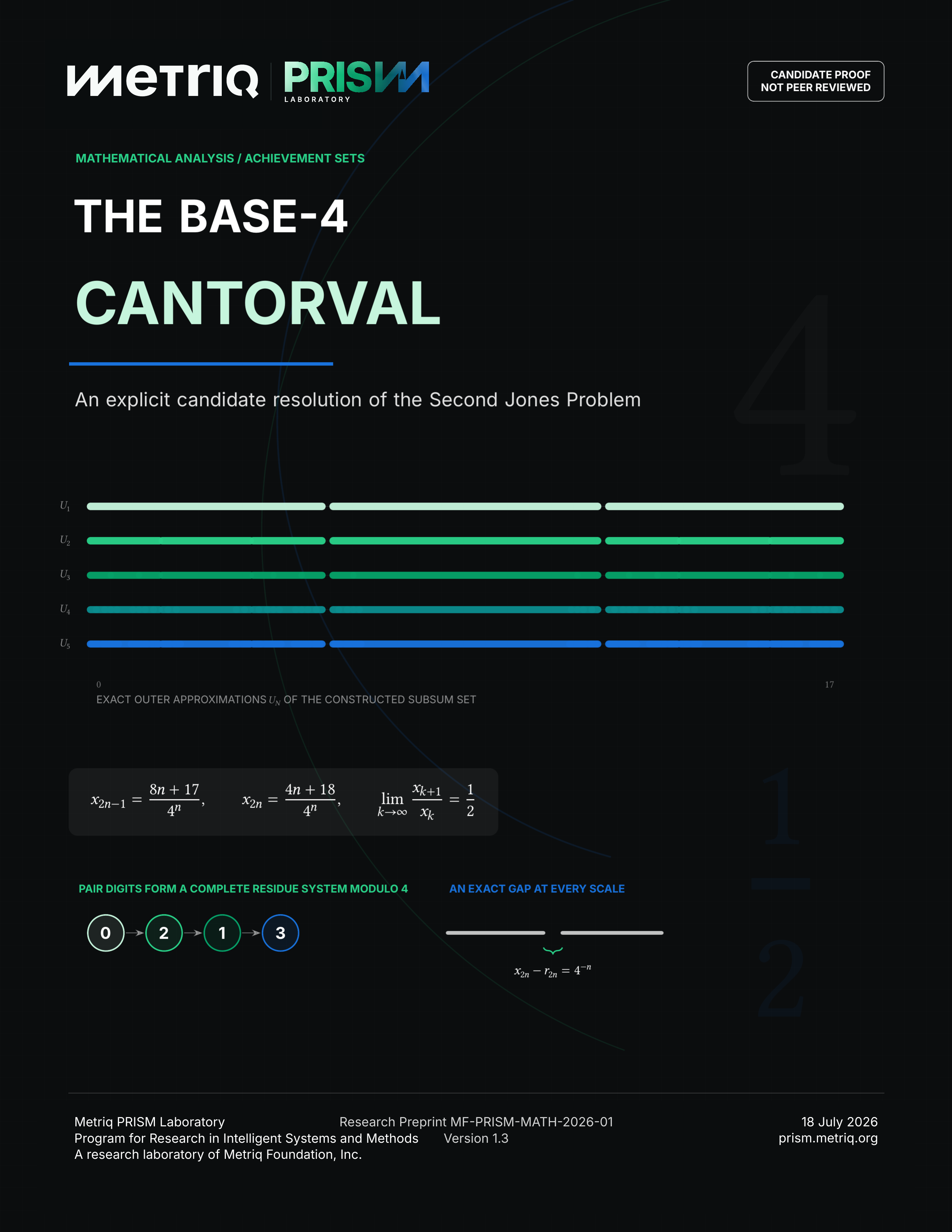
An explicit base-4 achievement-set construction presented as a candidate affirmative solution to the Second Jones Problem. The proposed sequence is strictly decreasing, sums to 17, has consecutive-term ratio converging to one half, and is argued to generate a Cantorval.
The question, construction, and claim.
This page is an interactive guide to the preprint. The manuscript and source package remain the controlling research record.
MF-MATH-2026-01, whose release remains preserved. Metriq PRISM Laboratory is the organizational creator; Daniel H. Jeffery is Research Director and corresponding contributor. Review the current files on GitHub ↗Can a positive summable sequence have a limiting consecutive-term ratio while its achievement set is a Cantorval?
How the paper approaches it
A two-term block at every base-4 scale is selected so its four pair sums form a complete residue system modulo 4 while an exact tail identity leaves a gap at every scale.
What the result would establish
Subject to independent review and prior-art verification, the construction would give an affirmative answer to the Second Jones Problem.
The proposed sequence has total sum 17, consecutive-term ratio converging to 1/2, nonempty achievement-set interior, and infinitely many gaps.
Work with the construction.
These interfaces reproduce finite structures and diagnostics described by the paper. They are explanatory tools, not substitutes for the infinite proofs.
Build the finite outer approximation.
Each completed pair contributes four possible digits. The remaining infinite tail is conservatively replaced by a full interval.
Achievement-set outer approximation
This display is an outer approximation, not a proof. The manuscript supplies the infinite interior and gap arguments.
Consecutive-term ratios
How the argument is assembled.
The paper separates the claim into proof obligations that can be reviewed independently.
Sequence identities
Prove positivity, strict decrease, summability, total sum 17, and convergence of the two alternating adjacent-ratio subsequences to 1/2.
Complete residues
Group terms into pairs. Their four possible numerators represent every residue modulo 4, producing finite base-4 grids at every depth.
Interior and gaps
Use compactness and a Baire-category argument for interior, then an exact tail identity to create a genuine gap after every completed pair.
Classification
Apply the corrected one-dimensional achievement-set trichotomy: interior excludes a Cantor set and infinitely many gaps exclude a finite union of intervals.
Exact checks and their limits.
Verification scripts test finite identities and consistency conditions. They do not replace the symbolic proofs of infinite statements.
All exact structural checks passed.
- complete residues modulo 4 for n=1,...,19
- residue bijection modulo 4^N for N=1,...,6
- monotonicity and exact tail-gap identities for n=1,...,39
- total sum agrees with 17 to an exact rational error below 10^-200
Formula-derived visuals.
The source package includes the scripts and files used to generate these figures.


Where criticism is most valuable.
A useful review identifies the exact theorem, equation, inference, or prior-art issue involved and distinguishes fatal defects from repairable exposition.
Interior argument
Audit the quotient bounds, compact finite translate union, density of base-4 grids, and the Baire-category contradiction.
Gap construction
Check the exact tail identity, endpoint membership, exclusion of intermediate subsums, and distinctness of the gaps.
Prior art
Search for equivalent constructions under scaling, finite blocking, reindexing, or alternate digit notation.
Cite the version you reviewed.
State that the result was a candidate preprint and had not undergone peer review at the time of citation.
Metriq PRISM Laboratory. (2026). An Explicit Cantorval Achievement Set with Convergent Consecutive-Term Ratio (Version 1.3) [Candidate research preprint]. Metriq Foundation, Inc. https://doi.org/10.5281/zenodo.21434379