

MF-PRISM-MATH-2026-06 / v2.2
Candidate preprint · Not peer reviewed
Finite Certificates for Three Unresolved Cardinal-Function Ranges
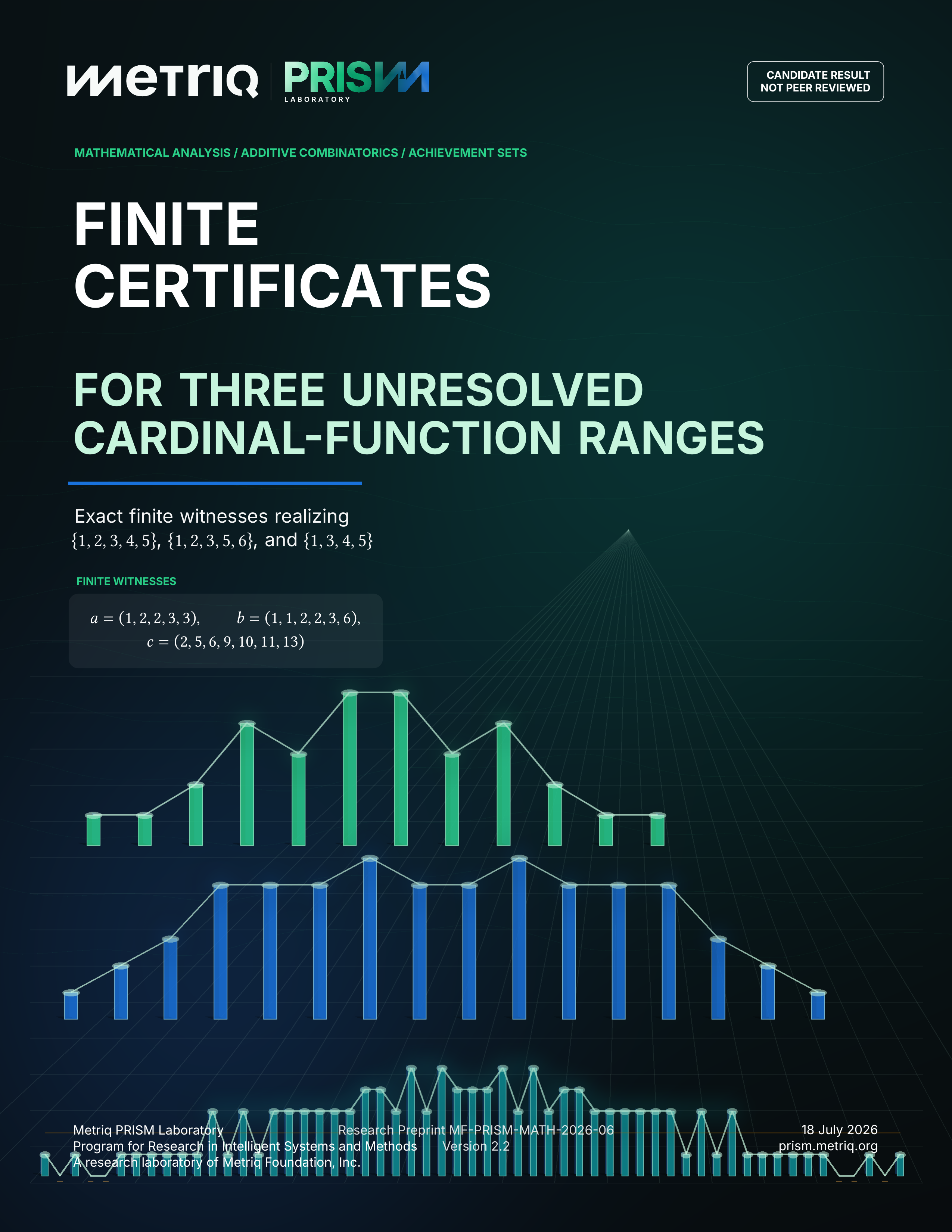
Version 2.2 presents three exact finite subset-sum certificates for unresolved cardinal-function ranges, together with Cantor-set extensions and reproducible verification. The interactive explorer on this site visualizes the first two certificates; the canonical repository contains the complete current paper.
The question, construction, and claim.
This page is an interactive guide to the preprint. The manuscript and source package remain the controlling research record.
MF-MATH-2026-06, whose release remains preserved. Metriq PRISM Laboratory is the organizational creator; Daniel H. Jeffery is Research Director and corresponding contributor. Review the current files on GitHub ↗Can two ranges left blank in a recent classification table be realized as subset-sum representation counts?
How the paper approaches it
Compute coefficients of the finite generating polynomial ∏ᵢ(1 + zˣⁱ). Two short integer sequences yield the target coefficient ranges, then a uniquely represented Cantor tail preserves every multiplicity.
What the result would establish
Unlike the other candidate arguments, the central certificates are finite and exactly enumerable. The remaining uncertainty concerns table interpretation, prior art, and novelty.
The current paper presents three exact finite certificates. This website explorer exposes the first two constructions and their Cantor-set extensions; Version 2.2 in GitHub contains the complete third certificate.
Work with the construction.
These interfaces reproduce finite structures and diagnostics described by the paper. They are explanatory tools, not substitutes for the infinite proofs.
Inspect each finite certificate.
Every bar is the exact number of indexed subsets that produce a given total. Select a bar to inspect the corresponding representations.
Coefficient spectrum
Selected representations
—
How the argument is assembled.
The paper separates the claim into proof obligations that can be reviewed independently.
Coefficient identity
The coefficient of zᵗ in ∏ᵢ(1 + zˣⁱ) counts subsets of the indexed sequence whose sum is t.
Certificate A
Expand (1 + z)(1 + z²)²(1 + z³)² and read the positive coefficient set {1,2,3,4,5}.
Certificate B
Expand (1 + z)²(1 + z²)²(1 + z³)(1 + z⁶) and obtain {1,2,3,5,6}, with multiplicity 4 omitted.
Cantorization
Append τₙ = 3⁻ⁿ. Unique tail representations and disjoint integer translates preserve the finite multiplicities while producing a Cantor set.
Third certificate
Version 2.2 adds a third finite witness, verified by exact polynomial multiplication and exhaustive enumeration. Consult the canonical repository for the sequence, range, and full proof.
Exact checks and their limits.
Verification scripts test finite identities and consistency conditions. They do not replace the symbolic proofs of infinite statements.
MF-PRISM-MATH-2026-06 exact verification
===================================
Certificate A
  sequence: (1, 2, 2, 3, 3)
  total sum: 11
  coefficients: (1, 1, 2, 4, 3, 5, 5, 3, 4, 2, 1, 1)
  coefficient range: [1, 2, 3, 4, 5]
  coefficient sum: 32 = 2^5
  polynomial: 1 + z + 2z^2 + 4z^3 + 3z^4 + 5z^5 + 5z^6 + 3z^7 + 4z^8 + 2z^9 + z^10 + z^11
  checks: DP = direct enumeration; palindromic; no zero coefficients; PASS

Certificate B
  sequence: (1, 1, 2, 2, 3, 6)
  total sum: 15
  coefficients: (1, 2, 3, 5, 5, 5, 6, 5, 5, 6, 5, 5, 5, 3, 2, 1)
  coefficient range: [1, 2, 3, 5, 6]
  coefficient sum: 64 = 2^6
  polynomial: 1 + 2z + 3z^2 + 5z^3 + 5z^4 + 5z^5 + 6z^6 + 5z^7 + 5z^8 + 6z^9 + 5z^10 + 5z^11 + 5z^12 + 3z^13 + 2z^14 + z^15
  checks: DP = direct enumeration; palindromic; no zero coefficients; PASS

Cantor tail
  tau_n = 3^{-n}
  total = 1/2
  tail after n = 1/(2*3^n) < 1/3^n
  distinct integer translates have separation at least 1 > 1/2
  uniqueness/disjointness checks: PASS

ALL EXACT CHECKS PASSEDFormula-derived visuals.
The source package includes the scripts and files used to generate these figures.


Where criticism is most valuable.
A useful review identifies the exact theorem, equation, inference, or prior-art issue involved and distinguishes fatal defects from repairable exposition.
Table interpretation
Confirm the classification classes and that the cited table leaves exactly the claimed entries unresolved.
Polynomial expansions
Verify both identities with repeated sequence values treated as distinct indices.
Novelty and Cantorization
Search for equivalent finite witnesses and audit the uniqueness, separation, and homeomorphism arguments for the tail extension.
Cite the version you reviewed.
State that the result was a candidate preprint and had not undergone peer review at the time of citation.
Metriq PRISM Laboratory. (2026). Finite Certificates for Three Unresolved Cardinal-Function Ranges (Version 2.2) [Candidate research preprint]. Metriq Foundation, Inc. https://doi.org/10.5281/zenodo.21434632