
MF-PRISM-MATH-2026-05 / v1.2
Publication hold
A Note on the Literal Formulation of Problem 13 for Fast Achievement-Set Sumsets
An interpretation note analyzing the literal formulation of Problem 13 and a middle-third witness. Publication remains on hold pending clarification of the source authors' intended formulation.
Publication remains on hold pending source-author clarification. This page preserves the record; it does not announce a resolved problem.
The question, construction, and claim.
This page is an interactive guide to the preprint. The manuscript and source package remain the controlling research record.
MF-MATH-2026-05, whose release remains preserved. Metriq PRISM Laboratory is the organizational creator; Daniel H. Jeffery is Research Director and corresponding contributor. Review the current files on GitHub ↗Can the constant 3 in the condition 3ⁿrₙ → 0 be replaced by a smaller constant while preserving the stated sumset conclusion?
How the paper approaches it
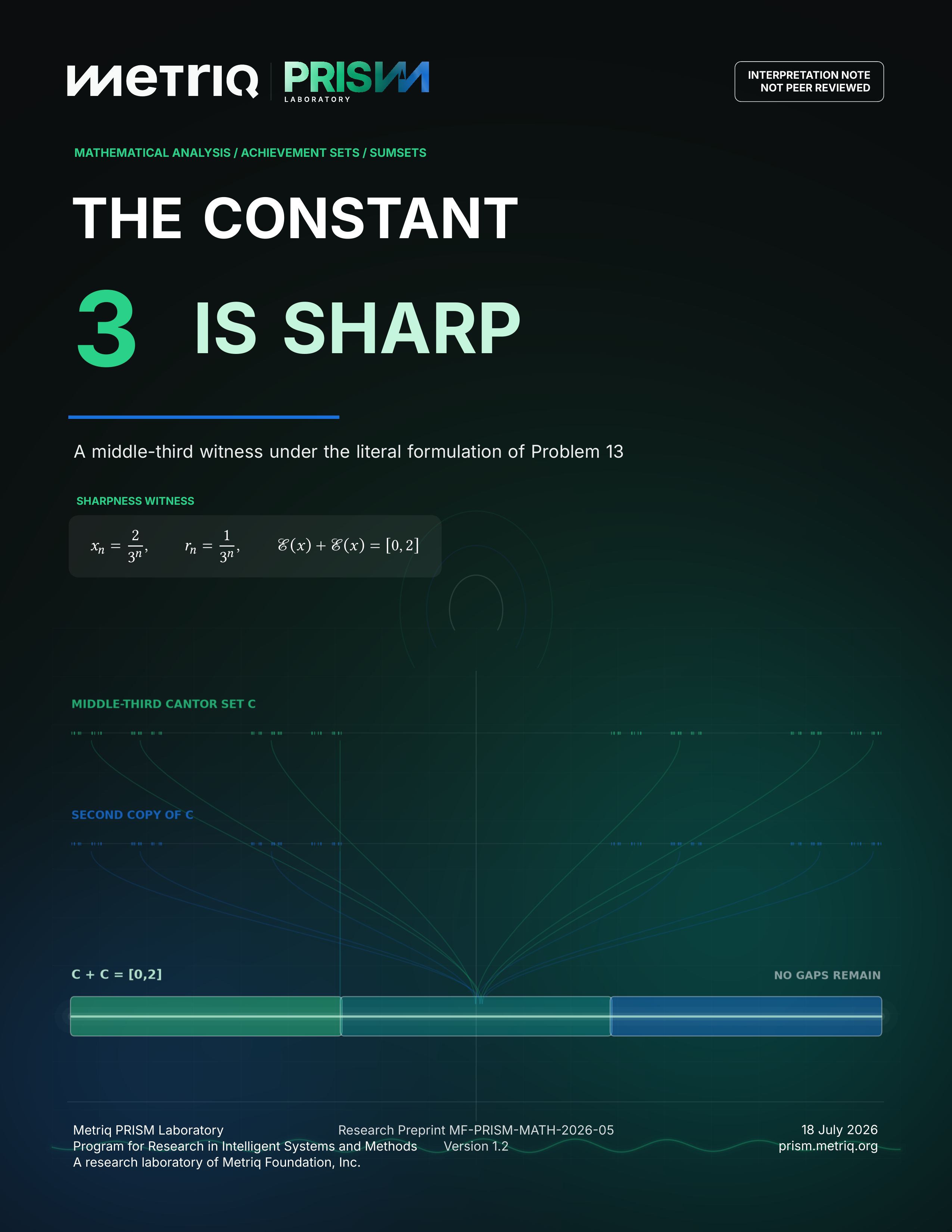
Use the normalized middle-third sequence xₙ = 2/3ⁿ. Its tail is rₙ = 1/3ⁿ, so every replacement c < 3 satisfies cⁿrₙ → 0, yet the achievement set is the standard Cantor set.
What the result would establish
The example isolates a sharp threshold using a classical object. The principal review issue is interpretive: whether the cited problem intended an additional hypothesis that excludes this boundary example.
For every fixed 0 < c < 3, the modified exponential condition holds, but E(x) + E(x) = [0,2]. Therefore the literal constant 3 cannot be lowered.
Work with the construction.
These interfaces reproduce finite structures and diagnostics described by the paper. They are explanatory tools, not substitutes for the infinite proofs.
Move the proposed replacement constant.
The upper plot tracks log₁₀((c/3)ⁿ). The lower display contrasts the sparse Cantor set with its full interval self-sum.
Modified exponential condition
Cantor set and its self-sum
How the argument is assembled.
The paper separates the claim into proof obligations that can be reviewed independently.
Tail identity
Compute the exact remainder rₙ = 3⁻ⁿ and verify the sequence is fast because xₙ = 2rₙ > rₙ.
Modified condition
For any proposed replacement c < 3, the expression cⁿrₙ equals (c/3)ⁿ and converges to zero.
Cantor identification
The subsums use ternary digits 0 and 2, so the achievement set is the standard middle-third Cantor set C.
Digit recombination
Every ternary digit 0, 1, or 2 splits into two binary digits. This gives every point of [0,2] as a sum of two points of C.
Exact checks and their limits.
Verification scripts test finite identities and consistency conditions. They do not replace the symbolic proofs of infinite statements.
Exact checks passed.
Main example: x_n=2/3^n, r_n=1/3^n, x_n=2r_n.
For every c<3, c^n r_n=(c/3)^n -> 0.
Ternary digits 0,1,2 cover every prefix; hence E(x)+E(x)=[0,2].
Generalization checked for m=2,...,8: x_n=m/(m+1)^n and mE=[0,m].
Formula-derived visuals.
The source package includes the scripts and files used to generate these figures.


Where criticism is most valuable.
A useful review identifies the exact theorem, equation, inference, or prior-art issue involved and distinguishes fatal defects from repairable exposition.
Problem wording
Confirm the source article’s remainder convention and exact intended meaning of “smaller number.”
Hidden hypotheses
Determine whether an omitted restriction was intended to exclude geometric boundary examples.
Prior recognition
Search errata, correspondence, workshop notes, and later versions because the witness is classical and unusually short.
Cite the version you reviewed.
State that the result was a candidate preprint and had not undergone peer review at the time of citation.
Metriq PRISM Laboratory. (2026). A Note on the Literal Formulation of Problem 13 for Fast Achievement-Set Sumsets (Version 1.2) [Candidate research preprint]. Metriq Foundation, Inc. https://doi.org/10.5281/zenodo.21434602