Fix the incident lineage
Represent merges, splits, and attribution changes explicitly so the comparison continues to refer to the same incident object.
INTERACTIVE RESEARCH GUIDE
Hold the incident lineage fixed while a reporting boundary absorbs a neighboring fire.
Incident A begins at 100 area units. Neighbor B has 80. A meaningful growth comparison must specify which lineage is being followed.
A actually grows by 20%. Comparing the merged report with old A gives 100%: the extra 80 percentage points come from B.
Apparent change = physical change + change in attribution
Set A’s growth to zero and choose the merged report. The naive comparison still reports 80% growth; lineage-stable growth is zero.
What this experiment represents. Synthetic disjoint-rectangle area accounting, not a real fire perimeter, geospatial model or validated forecast. Thermal detections must not be treated as observed burned-area boundaries.
Sharp growth bounds, detection-footprint witnesses, and shared-history evaluation
Define fire growth relative to a fixed incident lineage and compatible spatial histories, rather than combining incomparable boundaries. Finite geometry primitives and a small public scalar audit support the proposed research method.
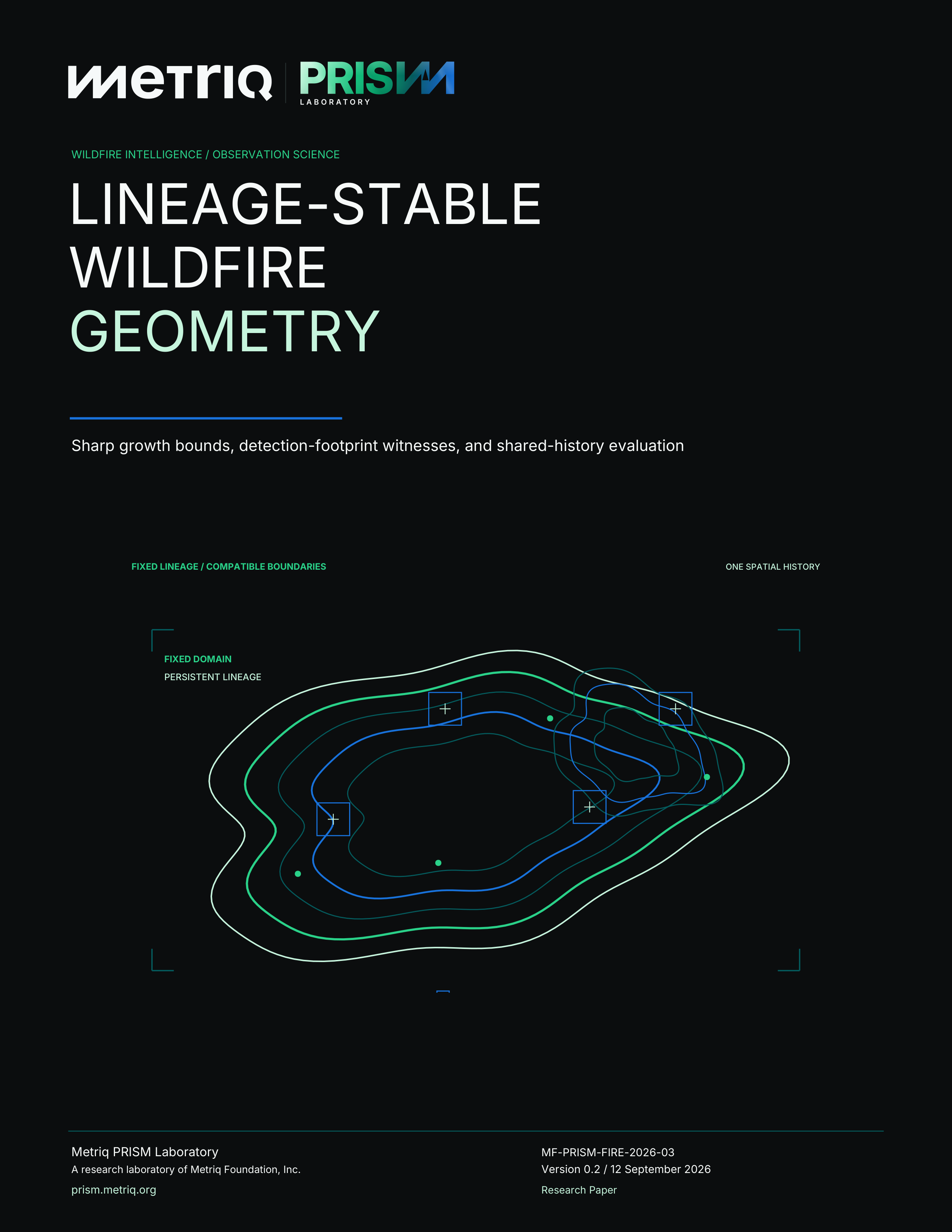
The paper prevents false geometry comparisons by requiring every perimeter or detection footprint to belong to one fixed incident lineage and one compatible spatial history.
Wildfire records change identity over time. Incidents merge, split, are renamed, absorb neighboring fires, and switch between sensor footprints and mapped burned-area boundaries. Comparing two shapes without tracking those changes can create meaningless growth.
The paper defines a lineage-stable object first, then asks which spatial histories are compatible with the observations. Growth bounds are computed only across those shared histories.
Represent merges, splits, and attribution changes explicitly so the comparison continues to refer to the same incident object.
Distinguish thermal-detection footprints from observed or mapped burned-area boundaries.
Construct feasible histories and derive endpoint certificates for the minimum and maximum compatible growth.
Apparent perimeter growth is rejected when the underlying incident lineage or geometry type changed.
Finite geometry primitives produce auditable lower and upper bounds across compatible histories.
The paper includes synthetic checks and a limited public scalar audit, not a validated operational spread model.
Conditional geometric bounds, synthetic checks, and a limited public scalar audit. No real-fire geometry model has been validated. Research only; not an official emergency warning.
This paper defines how to measure fire growth against a fixed incident lineage. It provides geometric constructions, synthetic tests and a small audit of public data, and makes no forecast of real fire perimeters.
No real-fire geometry forecasting skill has been established.
A thermal detection footprint is not the same thing as a burned-area perimeter.
Lineage assignments and fixed support remain consequential modeling choices.
Merges, splits, attribution changes, and sensor footprints can make apparent perimeter growth meaningless. A lineage-stable method keeps the comparison object fixed.
These are the terms needed to understand the claim. The full paper uses them more precisely.
The tracked identity of a fire through renaming, merging, splitting, and attribution changes.
A boundary used to represent the spatial extent of a fire at a given time.
The spatial support of a sensor detection, which may be larger or different from the burned area.
A sequence of geometries consistent with the stated observations and constraints.
This page is a reading guide, not a substitute for the manuscript. The public record links the explanation to the paper, source package, review materials, and persistent identifier.